 fleshlight.ai
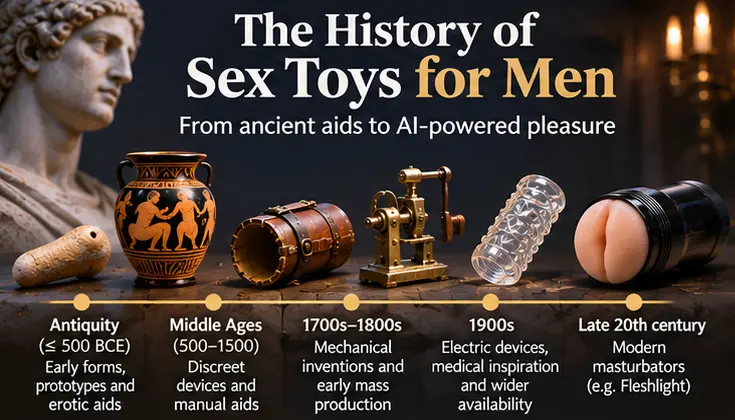
The history of sex toys for men: from ancient artifacts to AI strokers
Sex toys for men are older than you might think. The first sleeve on record dates from 1695. The newest ones watch a video and move with it.
In between came shame, patents and clever engineering. This guide walks you through the key moments. Every date and number has a source. You find them all at the end.
The history of male sex toys in short
Here is the whole story in one minute. Edo Japan had a hand-held sleeve by 1695. Victorian doctors then fought masturbation with metal devices.
In 1974, Ted Nelson coined the word “dildonics”. In 1990, Howard Rheingold made it “teledildonics”. The Fleshlight patent followed in 1998.
TENGA brought design to the shelf in 2005. Connected toys arrived from 2009. Since then, toys have learned to sync with video. In 2026, some read a video on their own.
Edo Japan: the first sleeve on record
The oldest male toy we could trace is Japanese. It is called the “Azumagata”. The magazine FRIDAY places it in a 1695 novel. That novel is called “Kōshoku Tabimakura.”
A shop called Yotsumeya sold it in Edo, says FRIDAY. Edo is the old name for Tokyo. In today’s terms, it was an adult goods store.
FRIDAY calls the Azumagata the root of the onahole. An onahole is the Japanese name for a masturbation sleeve. We found no museum record of one, though. So treat this as one journalist’s account, not settled history.

The Victorian war on masturbation
Europe took the opposite road. For a long time, masturbation was seen as a disease. London’s Science Museum holds proof of how far this went.
Its collection includes a “male anti-masturbation device”. It was made in Britain between 1871 and 1930. It is built from metal and leather.
The museum explains the thinking behind it. Many people thought masturbation harmed your health. That belief held until the early 1900s. It was even blamed for insanity.
It also holds “jugum penis” rings from 1880 to 1920. These were jagged metal rings fitted around the penis. Their only job was to make arousal painful.
A very different idea of health
- Doctors once treated masturbation as a serious threat.
- Devices were designed to stop it, not to help.
- That stigma lasted well into the 20th century.

Teledildonics: a word before the technology
The idea of connected sex came long before the hardware. In 1974, Ted Nelson wrote “Computer Lib/Dream Machines”. In that book, he coined the word “dildonics”.
Writer Howard Rheingold then added “tele” to the front. His article “Teledildonics: Reach Out & Touch Someone” ran in 1990. It appeared in the second issue of Mondo 2000 magazine.
In his 1991 book “Virtual Reality,” Rheingold went further. He predicted “portable telediddlers” would be “ubiquitous” by 2020. He was early, but not entirely wrong.
1998: the Fleshlight is born
The modern industry starts with a former police officer. Steve Shubin served with the Los Angeles police. His idea came at a very personal moment.
His wife Kathy was pregnant with twins. The couple had been told to avoid sex. Shubin decided to build something better than his hand.
He filed his first patent in 1996. Its title was “Device for discreet sperm collection”. It describes a flashlight-shaped case with a soft insert. That insert “feels like human flesh,” the patent says.
Two patents were granted in 1998, in July and September. Shubin dates the commercial start to 1998, too.
How the Fleshlight grew
Selling it was the hard part. Where do you even sell a product like this? In 1998, there were few good answers.
His $50,000 budget grew to $750,000. In 2002, he moved sales online. The website made $1.9 million in its first year.
By 2012, the company made 4,000 units a day. It had sold more than 5 million units by then. Today, Fleshlight’s own website claims over 12 million sold. The parent company is Interactive Life Forms, in Austin, Texas.
2005: TENGA brings design to the shelf
Japan returned to the story in 2005. Koichi Matsumoto left a job in the car industry. He put his savings into a new brand called TENGA.
TENGA went on sale in 2005. Its own press release marks July 7 as its anniversary. TENGA looked more like design than a sex toy.
The approach worked at a huge scale. By 2015, TENGA had shipped over 37 million units. It passed 100 million units in December 2021. By 2024, sales reached 148 million products in 73 countries.
2009: RealTouch and the first connected toys
Video and toys first met in the United States. AEBN was a big seller of adult video on demand. In late 2009, it launched a device called RealTouch.
RealTouch cost $199.95, with 60 free minutes. After that, synced video cost 49 cents a minute. New Atlas called it the first virtual male sex device.
It was bulky and tied to one video store. Still, it proved one thing. People wanted toys that followed what they watched.
Long-distance touch: Lovense and Kiiroo
Next came toys that connect two people. Tech.co reports that Lovense began in 2009. A co-founder’s long-distance relationship inspired it.
Lovense made Max for men and Nora for women. Each toy could sense the other’s movement. Partners could feel each other from far away.
Kiiroo started in Amsterdam in 2013. In 2014, it launched Onyx for men and Pearl. Kiiroo calls this real-time, long-distance touch.
In 2017, Kiiroo teamed up with Fleshlight. The Fleshlight Launch cost $199.95 and synced to video. Pornhub then added an “Interactive” category for Kiiroo toys. Kiiroo’s Keon followed in 2020.
Autoblow teaches a machine with video
Autoblow took a different path. It wanted a machine that simulates oral sex. To do that, it studied real footage.
Its research paper describes 1,145 videos. They were cut to 1,060 clips, almost 109 hours long. Each frame was annotated, more than six million in total.
From that data, Autoblow found 16 distinct motions. A neural network learned to chain them together. The result was the Autoblow AI. In 2018, it cost $129.
Buyers liked the idea. Its crowdfunding raised $755,000 by October 2019. Trade magazine ETO called that a male toy record.
What this AI does, and does not do
- It creates a new pattern of motion each session.
- It learned those patterns from annotated video.
- It does not react to your body or your mood.
The Handy and the stroking machine
Norway joined the story with The Handy. It was made by SweetTech AS. Its founders were Alexander Arish Bjørkmann and Jens Petter Wilhelmsen.
The Handy moved a sleeve with a brushless motor. It synced to video over Wi-Fi. In October 2020, Orion became its exclusive distributor.
The maker is now called Ohdoki. It says the original sold over 200,000 units. The Handy 2 went to Kickstarter in 2025. It raised $500,000 in its first 48 hours.
The campaign closed with $1,510,547 from 5,264 backers. Its goal had been just $10,000. Both Handy 2 models launched at CES in January 2026.
Air instead of friction: Arcwave Ion
Not every new idea involved stroking. In 2020, WOW Tech Group launched the Arcwave Ion. It uses air pulses instead of friction.
The technology came from Womanizer, a toy for women. Womanizer introduced its “Pleasure Air” in 2014. Arcwave’s team reworked it for the male body.
The idea began in a Berlin lab in 2017. It took 13 rounds of prototypes to get right. The Ion aims its air pulses at the frenulum.
2026: toys that watch with you
For years, video sync needed a script. A script is a file of movements for the toy. People wrote these scripts by hand, video by video.
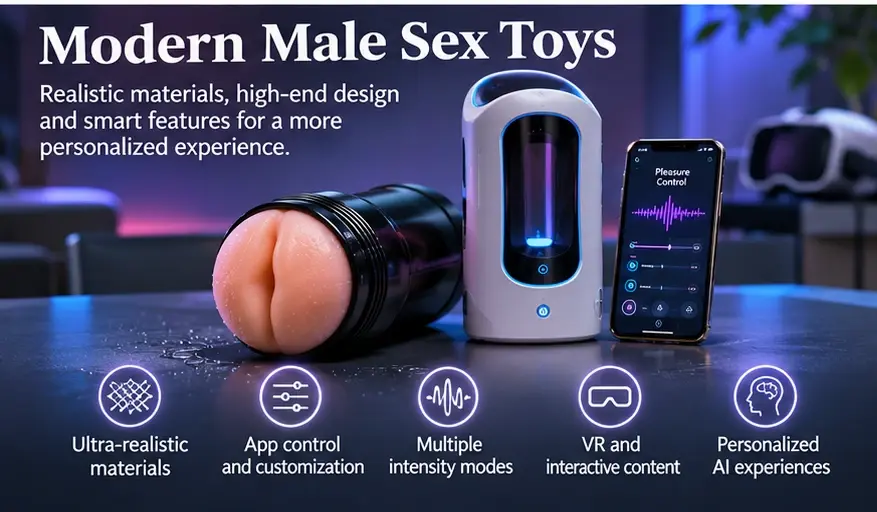
That is changing now. Kiiroo began building FeelMe AI in 2022. Today it syncs ordinary videos on more than 200 sites. The first month is free. After that, it costs under two dollars.
Lovense AI Sync does something similar. Lovense says you can “feel whatever you are watching”. Its Solace Pro is a thrusting machine built for it.
Kiiroo also announced the Keon 2 in May 2026. It is designed to fit almost any sleeve brand. Want to compare today’s models? Read our 2026 ranking.
How attitudes changed
Sex toys used to be seen as something for women. Research shows that men use them too. Indiana University studied 1,047 American men in 2009.
It found that 44.8% had used a vibrator during sex. That held true regardless of sexual orientation. Condom maker Trojan funded the study.
A 2020 survey of 3,000 men pointed the same way. It found that 29% use sex toys regularly. The most common reason given was better orgasms. Arcwave paid for that survey, so read it with care.
Our verdict
This history moves from shame to engineering. Victorian devices tried to stop pleasure. Today’s devices try to make it smarter.
The biggest steps came from small companies with big ideas. A police officer built the Fleshlight. A former car worker built TENGA. A Norwegian startup built The Handy.
Where we are in 2026
- Strokers sync with video and VR.
- Some read ordinary videos with AI.
- Talking about male toys is no longer taboo.
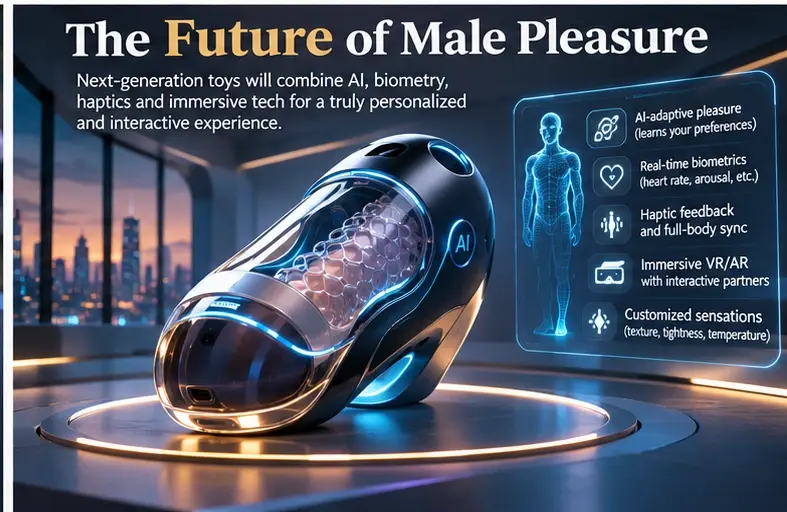
The next chapter is AI that truly responds to you. No toy we know of does that yet. Our guess is that it will not take long.
Frequently asked questions
Who invented the Fleshlight?
Steve Shubin, a former Los Angeles police officer. He filed his first patent in 1996. The product went on sale in 1998.
What was the first sex toy for men?
The oldest one we could trace is the Japanese Azumagata. It appears in a novel from 1695. No museum holds one. So that date rests on one source.
What does teledildonics mean?
It means sex toys that connect over a network. Ted Nelson coined “dildonics” in 1974. Howard Rheingold added “tele” in 1990.
When did sex toys for men get AI?
Autoblow sold an AI toy in 2018. It learned motion patterns from video. Real-time AI video sync is more recent. Kiiroo and Lovense offer it.
How many Fleshlights have been sold?
Fleshlight’s own website claims over 12 million units. In 2012, the figure was more than 5 million.
Sources
- FRIDAY (Kodansha) – the Azumagata in Edo Japan — read 2026-11-05
- Science Museum Group – male anti-masturbation device, 1871–1930 — read 2026-11-05
- Science Museum Group – jugum penis rings, 1880–1920 — read 2026-11-05
- Future of Sex – Howard Rheingold on teledildonics — read 2026-11-05
- Mondo 2000, issue 2 (1990), on Archive.org — read 2026-11-05
- Salon – Rheingold’s 2020 prediction — read 2026-11-05
- Google Patents – US 5,807,360 — read 2026-11-05
- Google Patents – US 5,782,818 — read 2026-11-05
- Austin Chronicle – Pressing the Flesh (2012) — read 2026-11-05
- Fleshlight – About us — read 2026-11-05
- TENGA press release (2015) — read 2026-11-05
- Tokyo Weekender – Inside TENGA (2024) — read 2026-11-05
- ETO – TENGA ships 100 million units (2021) — read 2026-11-05
- Las Vegas Sun – RealTouch (2010) — read 2026-11-05
- New Atlas – RealTouch (2010) — read 2026-11-05
- Tech.co – Lovense (2014) — read 2026-11-05
- Kiiroo – Our story — read 2026-11-05
- TNW – Fleshlight Launch review (2017) — read 2026-11-05
- Gigazine – Pornhub adds an Interactive category (2017) — read 2026-11-05
- TechCrunch – the Autoblow A.I. (2018) — read 2026-11-05
- Autoblow – the research paper — read 2026-11-05
- ETO – Autoblow AI crowdfunding record (2019) — read 2026-11-05
- Arcwave Ion press kit (2020) — read 2026-11-05
- ETO – Orion and The Handy (2020) — read 2026-11-05
- Kicktraq – The Handy 2 Kickstarter — read 2026-11-05
- Ohdoki press release – $500,000 in 48 hours (2025) — read 2026-11-05
- Engadget – Handy 2 Pro at CES 2026 — read 2026-11-05
- ETO – Keon 2 announced (2026) — read 2026-11-05
- Kiiroo – FeelMe AI — read 2026-11-05
- Lovense – AI Sync — read 2026-11-05
- ScienceDaily – Indiana University study (2009) — read 2026-11-05